Every focus product on the shelf picked your dose before it knew your name — same scoop for a 119 lb analyst and a 250 lb lineman. SCRUPLE is a caffeine-free focus base with 190 mg of L-theanine a serving, printed on the label, and the math to pair it with your own caffeine at the ratios it was actually trialled at. The caffeine stays yours, so it can be measured properly.
Caffeine's effect scales with body mass — which is why sports-science dosing has always been written in mg per kilogram, not mg per container. The shelf ignores this completely.
A 160 mg can delivers about 2.1 mg/kg to a 165 lb adult and about 4.4 mg/kg to a 79 lb teenager. Identical product, radically different pharmacology.
The attention benefit that made theanine famous was measured at specific pairings — 200 mg theanine against 160 mg caffeine, for instance (RCT). A can with the caffeine sealed in cannot hold a ratio across body weights. A caffeine-free base can, because you set the caffeine.
Taurine appears at 1,000–3,000 mg in most cans. The only FDA GRAS notice found covers 45 ppm in enhanced water (GRN 586) — roughly a fiftieth of the label dose.
A dose is a quantity, not a gesture.
Every pouch in the founding batch is identical: 190 mg of L-theanine a serving, printed on the label. What changes is you. Give it your weight and it works out what that fixed dose means for your body, and the caffeine range it was actually trialled beside.
Your reading appears here once it opens.
| In every serving | Per 5.50 g |
|---|
Shown at the 75 kg Core serving. The erythritol is not there for sweetness — at roughly 1.0% in 350 mL it is the level above which it measurably suppresses bitterness, and it is what makes a 5.50 g serving large enough to scoop accurately in the first place.
| Ingredient | Amount | Why |
|---|---|---|
| L-Theanine | 190 mg | The active core. Sits inside the trialled ratios beside 95–152 mg of caffeine |
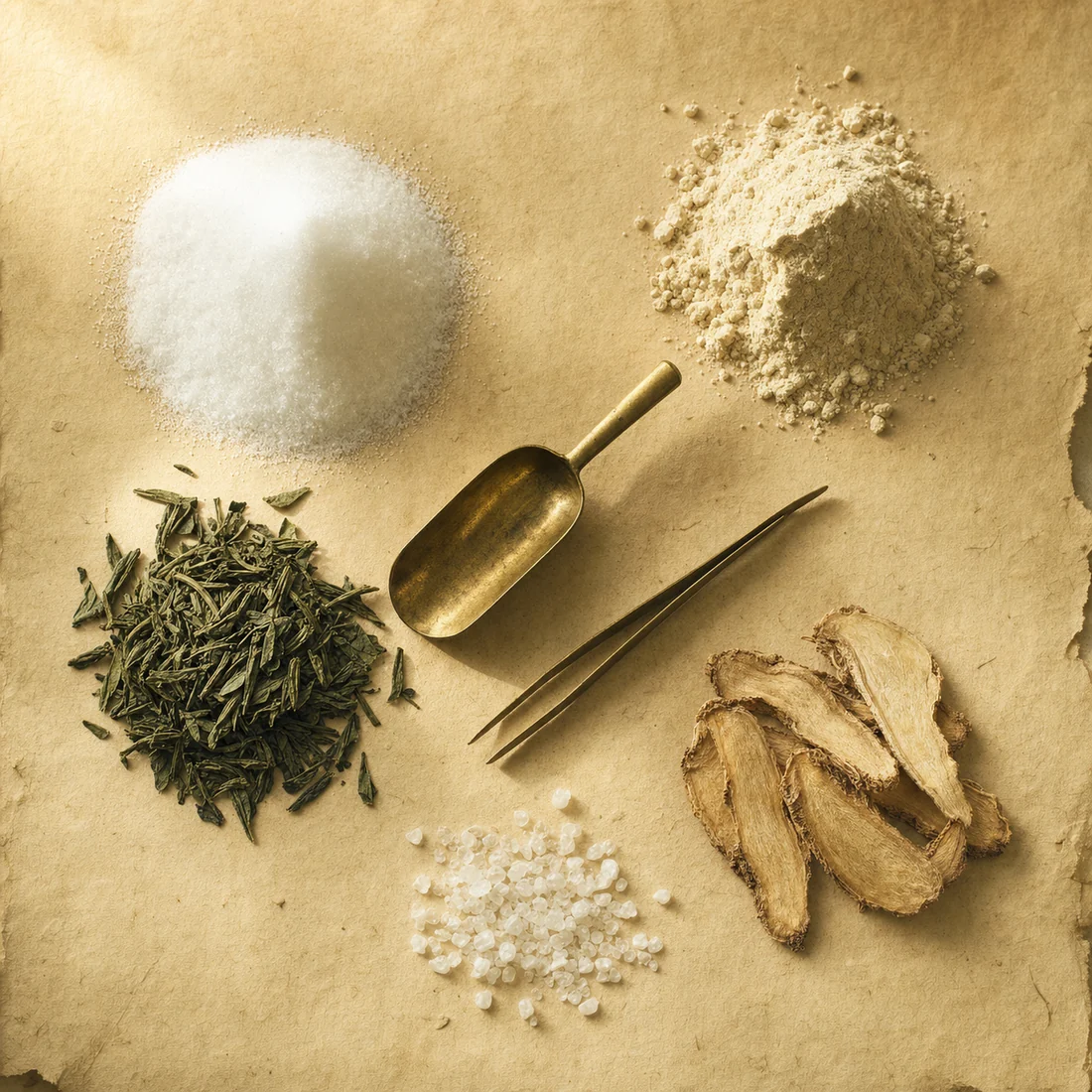
| Erythritol | 3,500 mg | Bitterness suppression and scoopable bulk |
| Sodium (citrate) | 200 mg | Palatability and buffer |
| Potassium (citrate) | 150 mg | Rounds the flavour; salts improve Reb M taste |
| Citric acid | 300 mg | Tartness |
| Natural flavour | 150 mg | Citrus or berry |
| Malic acid | 50 mg | Softens the citric edge |
| Reb M steviol glycoside | 40 mg | Less bitter and astringent than Reb A |
| Total powder mass | 5.50 g | Sodium and potassium are declared as the mineral; the powder carries the citrate salts, which are heavier |
Four ingredients that every competitor carries, and the specific reason each one failed. Note that cutting them made the formula cheaper — the evidence-led version is also the lower-cost version, which tells you what they were doing on those labels.
Its absorption peaks at 1–2.5 hours against caffeine's 15–60 minutes, a mismatch that "may limit their synergistic effects" (network meta-analysis). No standalone cognitive evidence at the doses used, and the only GRAS notice located covers 45 ppm in enhanced water (GRN 586).
The 500%-of-RDA B-complex on energy labels is cosmetic in adults who are not deficient. It buys a bright panel and a yellow tint, not attention. Where a B vitamin earns a place it is at a sane amount, not a headline multiple.
It degrades to creatinine in acidic solution — roughly 21% lost at pH 3.5 (GRN 931). Any acidic ready-to-drink product carrying a creatine claim is selling you a number measured at the filler, not at your mouth.
The FDA treats highly concentrated caffeine sold to consumers in bulk powder as adulterated, and for good reason — the difference between a dose and a hospital visit is a fraction of a teaspoon. Yours comes from a pre-measured capsule, tablet, or your own coffee.
Enter your weight once. The calculator shows what the fixed 190 mg means for your body and the caffeine it was trialled beside, so you pair it on purpose rather than by habit.
A pre-measured capsule or tablet at your target, or the coffee you were going to drink anyway — roughly 95 mg per 8 oz brewed, 64 mg per espresso shot. Convenient, but imprecise, so the capsule wins on days that matter.
Log it against your daily total. The FDA cites 400 mg a day as the amount not generally associated with dangerous effects in healthy adults. Everything counts toward it.
Stir into 350 mL cool water and give it 45–60 minutes. The trials measured attention at the 60-minute mark. Products that promise an instant hit are describing a sugar rush.
Including the inconvenient ones. If a claim only holds under a condition, the condition is printed next to it.
Meta-analysis of 31 randomised, double-blind, placebo-controlled trials across 1,455 rested healthy adults: accuracy g = 0.27, reaction time g = 0.28, with doses ≥ 200 mg outperforming lower ones (PubMed).
200 mg theanine with 160 mg caffeine in 37 overnight sleep-deprived adults improved hit rate (P = 0.02) and cut reaction time to hazards by 38.1 ms against placebo (P = 0.003) (PubMed). Attention-switching benefits appear at 60 minutes (RCT).
250 mg daily for 28 days reduced omission (p = 0.04) and commission (p = 0.03) errors (trial). No single-dose trial in healthy adults was found, so we say plainly: you will feel nothing on day one. It is not in the founding batch.
EFSA finds single doses up to 200 mg of caffeine and 400 mg a day raise no safety concern for healthy adults (EFSA). Our 2.0 mg/kg target caps at 160 mg regardless of weight — a heavier body does not license an unstudied dose.
Its solubility limit is 0.45–0.48 g/L (PubChem), so 750 mg in 500 mL stays a visible suspension no matter how hard you shake. Drink it promptly and swirl the glass — sediment left in the bottom is dose not taken. That is why it is not in the founding batch.
It "has been found to impair executive function and lower attentional control when people are in an emotionally aroused state" (Examine). If you need aggression rather than calm focus, this is the wrong product and we would rather say so here than in a refund email.
We are not pretending this is a finished company. The formula is specified, the costing is done, and the first blend runs when the batch is committed. A $25 deposit is how we find out whether this should exist — and it is the money that actually buys the ingredients.
$45 total, split. We save your card at checkout and charge the $20 only once the batch is blended and ready to ship — never before. The deposit is what pays the co-packer, so it is refundable in full, no questions and no form, until the batch funds at 265 reserved. After that it is committed to ingredients. We ship within 120 days of funding; if we are going to miss that, we email you before the deadline with a new date and you can cancel for a full refund. If the batch never funds, or the blend fails our own taste and solubility checks, every deposit is returned automatically.
Reserve my place — $25Not ready to commit? Just keep me posted — no deposit, no card, and we will email you when the batch opens.
Because caffeine is the one ingredient you can already buy accurately, cheaply, and in a pre-measured form — and because shipping it as loose powder is the single most dangerous thing a supplement company can do. The FDA treats highly concentrated bulk caffeine sold to consumers as adulterated precisely because a teaspoon can be a lethal dose. What is genuinely hard to get right is everything around it: theanine at a dose the trials used, electrolytes for palatability, and a bitterness-suppressing base. That is what you are buying.
It is a conservative point inside the range the literature uses. Caffeine dosing in sports and cognitive science is conventionally expressed per kilogram, and the trials our formula is built on ran between 40 and 200 mg. We target 2.0 mg/kg and then clamp hard at 160 mg, so a 100 kg adult gets 160 mg rather than the 200 mg the arithmetic wants. EFSA's single-dose no-concern level is 200 mg, and we deliberately stay under it.
Tart and light — closer to a citrus electrolyte drink than to an energy drink. L-theanine itself is sensory-neutral and highly water-soluble (PubChem), so it costs nothing in flavour. The erythritol at roughly 1.0% is doing real work suppressing bitterness rather than just sweetening.
You pay $25 now and $20 when the batch is ready to ship — $45 in total, the founding price. We save your card at checkout so the balance does not need you to come back to a link, and we do not touch it until the powder exists.
Here is the part most pre-orders leave out: your deposit is not sitting in an account somewhere. It is what buys the ingredients and pays the co-packer. So it is refundable in full, instantly and without a form, right up until the batch funds at 265 reserved — and after that it is spent on your pouch. We ship within 120 days of the batch funding. If we are going to miss that date we will email you before it passes with a revised date, and you can cancel for a full refund rather than wait. That is your right under the FTC's mail-order rule and we are not going to make you go looking for it. If the batch never funds, or the blend fails our own taste and solubility checks, every deposit is returned automatically and we will tell you exactly why.
The pouch contains no caffeine, so the safety question is really about the caffeine you add. Keep your daily total under the 400 mg the FDA cites for healthy adults, counting coffee and tea. Not for anyone under 18, pregnant or breastfeeding, sensitive to caffeine, or taking medication that interacts with it. Theanine can blunt attentional control in emotionally aroused states (Examine), so it suits calm focus rather than confrontation. Talk to your doctor before starting anything.
Eventually, and we will not pretend otherwise about why it is slow. A ready-to-drink SKU carries $20,000–$45,000 in formulation work and a minimum order of 25,000 units, and there is an open regulatory question — the GRAS notices covering L-theanine list teas, fruit drinks and sports beverages, but not energy drinks. The powder lets us prove the formula is worth drinking before anybody spends that money. Deposit holders get the can first.
The dose is the product.